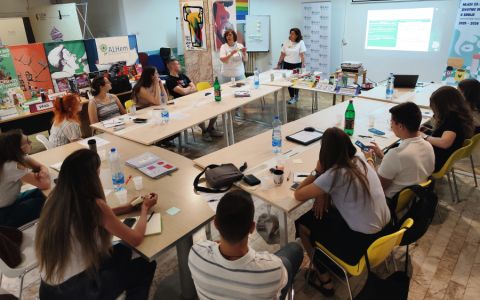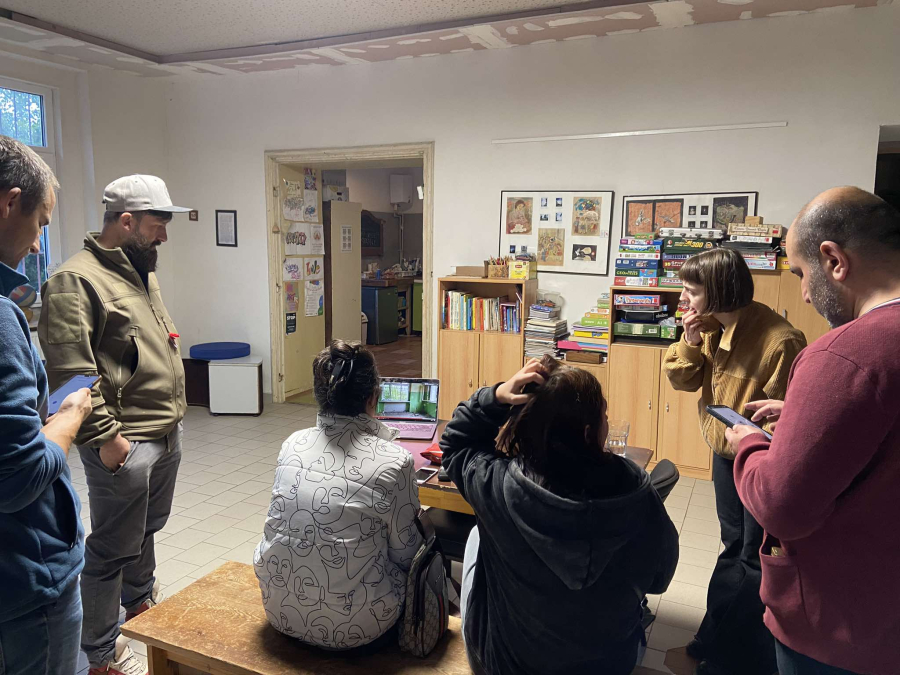
The legacy of the historic mining industry continues to affect many Armenian regions, leaving its mark on the landscape, the health of local people, and the social life of entire communities. On December 22, 2025, together with our Armenian partners from the Center for Community Mobilisation and Support (CCMS) and EcoLur, we gathered around one table to discuss how to address this legacy and look for pathways toward a more sustainable future.
More than 25 participants took part in the discussion, including environmental activists, members of ecological coalitions, and residents of mining-affected areas. Thanks to this diversity, we were able to explore effective ways to connect scientific knowledge with real-world experience, ensuring that the transformation of industrial areas is both environmentally sound and socially fair. Czech experience serves as an inspiration for Armenian partners who are developing their own model of just transition.
Scientific perspective: the risks of delay and the EU’s role
The introductory presentation was delivered by Mgr. Zuzana V. Harmáčková, Ph.D., head of the Department of Social-Ecological Analysis at the Global Change Research Institute CAS (CzechGlobe). She focused on the socio-ecological risks involved in postponing the transformation of mining regions.
She emphasized the importance of data, scenarios, and interdisciplinary research that guide strategic decisions about the future of these regions. Harmáčková also highlighted the role of the European Union, which promotes the concept of a just transition in its policies so that economic change takes into account both ecological and social dimensions.
She also underlined the need for international cooperation among scientists, policymakers, and communities, such as through the IPBES platform, which she has been actively involved with for many years.
Experience from the field: working with people and overcoming systemic barriers
A practical viewpoint was offered by Petr Globočník, a social worker and municipal councillor from Litvínov, a region in North Bohemia affected by brown coal mining. Using the example of his hometown, he illustrated how environmental issues are deeply connected with the social challenges of everyday life.
Globočník stressed the vital role of community centres and local initiatives, whose cultural activities can strengthen social ties and motivate residents to take part in improving their surroundings. He also openly pointed out systemic barriers, such as difficult communication with authorities, limited municipal powers, and a lack of long-term political support.
Shared challenges and mutual inspiration
During the discussion, Armenian participants asked how Czech experience could be applied in their own regions, what the role of the state should be, and how to better protect the health of people living in mining-affected areas.
The debate showed that despite differing local contexts, the key challenges are shared and revolve around the need for public participation and long-term planning.
A step toward deeper cooperation
The seminar “Just Transition” became another milestone in the ongoing cooperation between Czech and Armenian organizations. It brought together scientific perspectives, practical experience, and the voices of local communities, confirming that interdisciplinary dialogue is key to finding fairer and more sustainable paths of development.
These topics are being addressed within the project Ecological Transformation of Armenia’s Mining Areas, funded by the Czech Ministry of Foreign Affairs through the Transition Promotion Program.
A recording of the seminar is available here: https://youtu.be/2TLnD6-8LFw?si=T2mAu7Ab6lP3hHzb