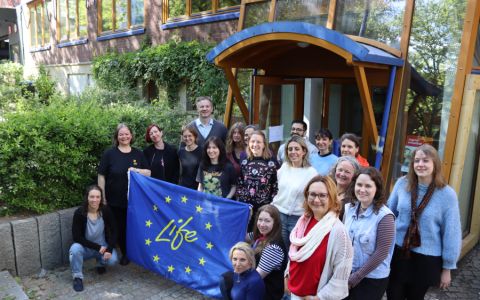
Moldovan volunteer rangers from several protected areas gained valuable experience and knowledge from their Czech peers from the Krkonoše National Park (KRNAP) during a week-long internship.
The Lower Dniester National Park or the Tipova Landscape Reserve are examples of Moldovan protected areas where volunteer rangers carry out their regular work. Four of them benefited from the opportunity to share their expertise with and gain new experience from joint work with Czech rangers from KRNAP during the first week of December.
After an initial meeting at the headquarters of the KRNAP administration in Vrchlabí, the rangers were taken on a field trip with the KRNAP zoologist who explained to them the practice of monitoring wolves, namely its implementation in collaboration with the National Park’s biologists and rangers. It also included, among other activities, photo-trap monitoring. This topic is potentially very relevant for Moldova as it has been observed that some larger carnivores have started to reappear again in the country.
Moldovan rangers were introduced to wildlife monitoring by the Head of the Nature Conservation Dept. of KRNAP. Afterwards, this was followed by a trip into the field with a member of the ranger team that deals with camera traps. Together they rearranged several cameras in the park for the purpose of monitoring winter conditions.
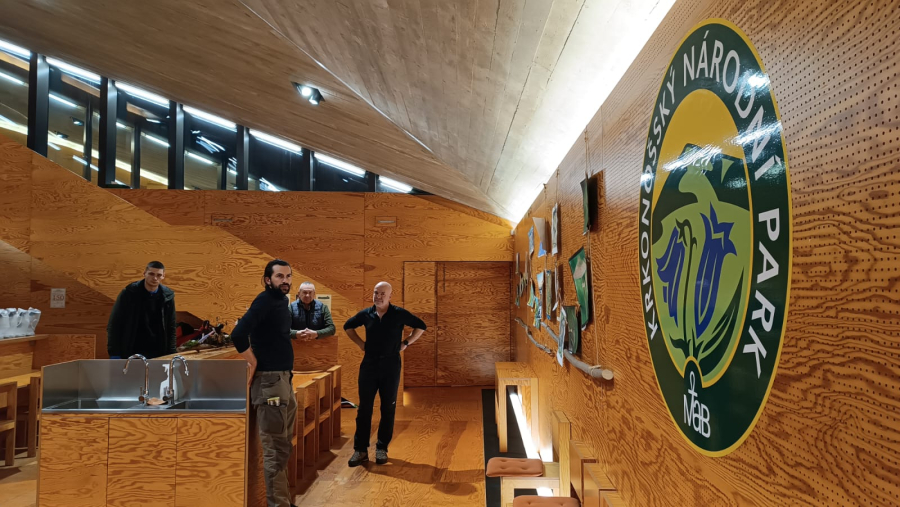
Another theme equally shared by the Czech and Moldovan nature protection communities is nature interpretation. KRNAP has its own - Centre for Environmental Education – Krtek, this was the place where the National Park’s Czech colleagues shared with their Moldovan colleagues, their experience from nature interpretation approaches and activities. The indoor programme was followed by the demonstration of a new approach to nature interpretation that took place in the field, developed jointly by local rangers and environmental educators - the Gaming Nature Trail - Vřetenovčí was followed by a fieldtrip to a seasonal winter hunting reserve/farm which covered topics such as deer management, hunting or the regulation of deer populations.
How can a powerful state, “green” organisation and a private commercial body effectively cooperate? This was the topic that was illustrated using the example of the Tree Top Walk located in Janské Lázně, which shows the fruitful use of nature interpretation as an approach, via the use of a tourist attraction point which helps the park to reach out to more audiences, and to raise more awareness about the park and its objectives, and at the same time enriches the visitors’ experience.
An important part of the internship was of course common activities that were carried out with the local rangers. The park territory is divided into 6 areas, including its sub-administrations. Rangers in each area have some differences in the nature and focus of their tasks. The area around the village of Pec pod Sněžkou must deal more with overtourism issues, so its rangers are mostly committed to communication with visitors and maintaining eco-tourism trails. The Moldovan rangers in cooperation with their Czech, KRNAP colleagues went on a joint patrol in the area, helping to prepare some tourist infrastructure for the winter season. Another area (with its office located in Horní Maršov) must deal a lot more with local communities and their perception of the park and the park’s rules. Together with a local ranger, the Moldovan team visited two seasonal winter red deer farms and discussed the strategies of the management of big herbivores in the park.
Overtourism being a major problem for many Czech protected areas, namely for the highest Czech mountain Sněžka, analysis of visitors and management of their flow was an essential part of a presentation provided by KRNAP before going on a patrol with one of KRNAP’s rangers. The afternoon programme included visiting revitalized drained wetlands (near Pec pod Sněžkou) or working on arranging ecotourism trails before the winter season.
Apart from fieldwork experiences, the Moldovan guests also visited KRNAP's woodcraft-manufacturer in the village of Svoboda nad Úpou – a place where visitor field mobiliary and info-panels (we can often see on trails in the mountains) are produced. They also found out more about the use of info-panels as an efficient communication tool from the park to its visitors and to the locals, and which challenges should be considered in this area.