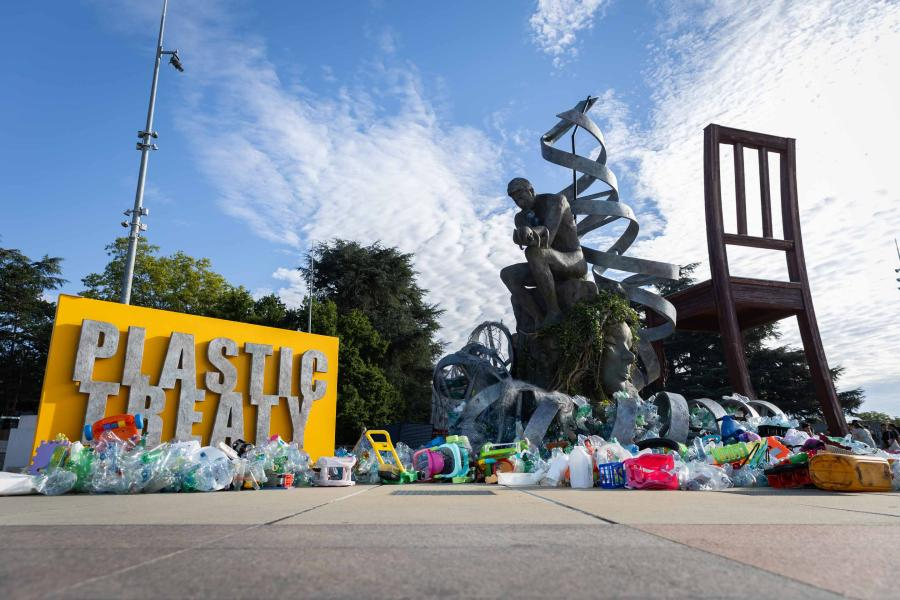
Negotiations that could determine the future of our planet and the health of generations to come are culminating in Geneva. Diplomats from around the world are attempting to agree on the final text of a global plastics treaty.
This, however, is no mere squabble over wording in an international document. It is a clash of two irreconcilable worlds. On one side are the scientific proofs of the devastating impacts of plastics and a coalition of ambitious states that want to genuinely solve the problem. On the other side is the powerful lobby of oil-producing nations and the petrochemical industry, which is trying to block any meaningful agreement. And as scientific studies show, there is much more at stake than just clean beaches.
The Overflowing Bathtub and Treating Cancer
The current situation in the negotiations is aptly described by an analogy used on-site by Jindřich Petrlík, a representative of the Czech organization Arnika: "When a bathtub is overflowing, you first have to turn off the water and only then deal with the flood." This is the precise point of the main dispute. While most developing countries in Africa, Asia, and Latin America, supported by Europe, demand that the treaty limit the production of primary plastics and ban the most toxic substances they contain, a coalition of "like-minded countries"—led by Saudi Arabia, Russia, Iran, and Kuwait, and newly joined by the United States—staunchly rejects such measures. They insist that the treaty should deal exclusively with waste, that is, with what has already spilled from the overflowing tub. "They are proposing to treat the pain caused by cancer, but not the cancer itself," Petrlík adds. Their goal is to maintain the status quo because, as a recent study in The Lancet shows, more than 98% of plastics are produced from fossil fuels, and the petrochemical industry sees them as a lifeline at a time when the world is cutting back on burning fossil fuels for energy.
This blocking tactic also has a concrete procedural form. Key negotiations are increasingly moved into closed "informal" groups, where observers from the scientific and non-governmental communities are denied access. The International Pollutant Elimination Network (IPEN), which has sixty representatives on site, strongly protested this procedure in an open letter. "As negotiations approach a critical phase, observers are being reduced to spectators," wrote IPEN co-chairs Pamela Miller and Yuyun Ismawati. It is a paradoxical situation: in the very rooms where a topic with such a massive impact on health is being decided, those who bring independent scientific data and the voice of the communities most affected by pollution are being silenced.
What Diplomats Don't Want to See: Scientific Facts About the Plastic Pandemic
Why is it so crucial to limit production? Because the numbers are stark. Global plastics production exploded from 2 megatons in 1950 to 475 megatons in 2022, and without intervention, it is projected to reach 1,200 megatons by 2060. Half of all plastics in history have been produced since 2010, yet less than 10% have ever been successfully recycled. The claim that we can "recycle our way out" of the crisis is a dangerous myth.
The aforementioned study in The Lancet clearly demonstrates that plastics harm human health at every stage of their life cycle. It begins with production, where the extraction and processing of fossil fuels release toxic substances that cause higher rates of asthma, leukemia, and other illnesses in people living near factories. During their use, plastics release a cocktail of more than 16,000 different substances, the vast majority of which lack publicly available data on their hazards. These agents, including phthalates, bisphenols, and "forever substances" (PFAS), are proven to disrupt the endocrine system, damage organs, and cause numerous non-communicable diseases such as cancer, diabetes, and cardiovascular conditions. Children are particularly vulnerable, as these substances can cause irreversible damage to brain development, weaken the immune system, and increase the risk of cancer in adulthood. The total health costs and productivity losses caused by plastics exceed $1.5 trillion annually. Nor do they cease to be a threat as waste. In the environment, plastics do not biodegrade but fragment into micro- and nanoplastics (MNPs), which have been found in human blood, brain, lungs, and even in the placenta and breast milk. Furthermore, these particles can act as vectors for other toxins and pathogenic bacteria, thereby contributing to the spread of antibiotic resistance.
The Future Is Being Written Now
The negotiations in Geneva are therefore a battle over whether the international community will give weight to these scientific facts or succumb to the pressure of an industry that profits from this health crisis. Adopting a weak treaty that focuses only on waste would be a Pyrrhic victory. It would be like signing an agreement on the need to build more hospitals for smokers while refusing to restrict the sale of cigarettes in any way.
World leaders must find the courage to turn off the overflowing tap at the source. This means adopting legally binding targets to reduce plastic production, banning the most dangerous hazardous substances, and promoting safe, non-toxic, and reusable alternatives. Anything less will be merely postponing the problem and a betrayal of the health of current and future generations, whom the coalition of blocking states so cynically holds hostage.